5 min read
A restaurant owner gets a 1-star Google review: "Cold food and slow service. Won't be back." He responds: "This is completely inaccurate. We pride ourselves on quality and service. Please contact management directly."
That exchange is still visible three months later to everyone who searches that restaurant. The original reviewer moved on long ago. The response is working against the business every single day.
Knowing how to respond to negative Google reviews is one of the most visible things a business owner does publicly, and most are doing it wrong.
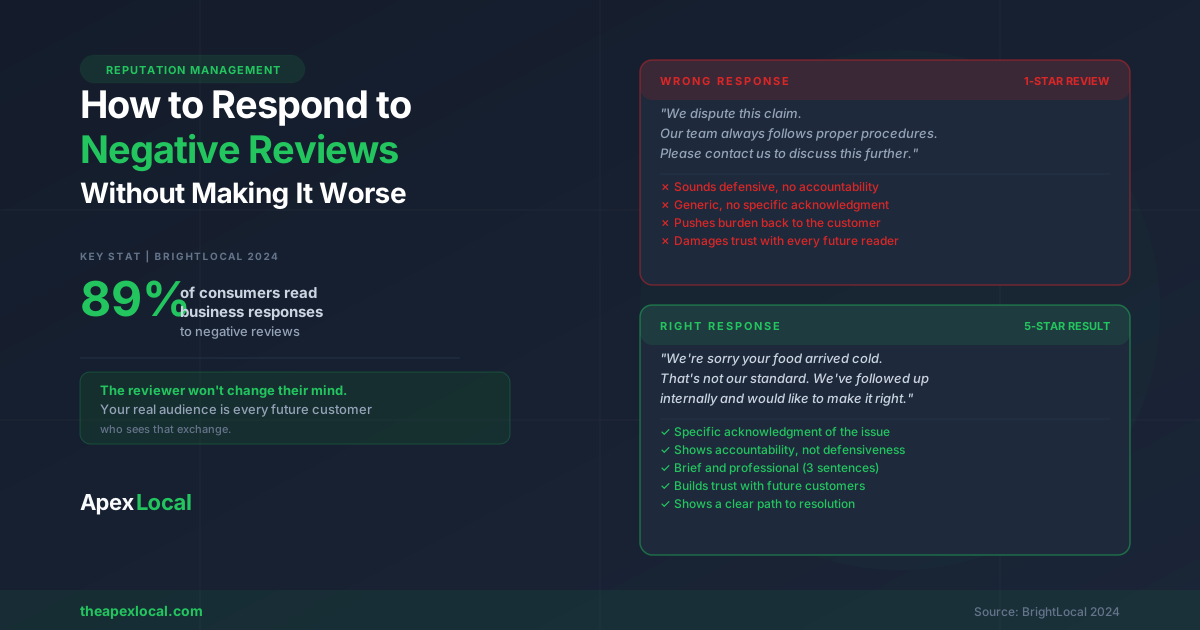
When someone reads a negative review, they almost always scroll to see what the business said. According to BrightLocal's 2024 Local Consumer Review Survey, 89% of consumers read business responses to negative reviews. Your response isn't just for the person who left it. It's for every future customer doing research.
The original reviewer probably isn't coming back regardless of what you write. Your real audience is the next hundred people who see that exchange.
This also matters for your Google Maps ranking. Responding to reviews consistently is one of the engagement signals that affects how your listing performs. As the top reasons competitors outrank local businesses on Google Maps makes clear, response rate is one of the signals that separates high-ranking listings from those that quietly slip down the map.
Most bad responses fall into one of four patterns:
Getting defensive: "This is completely inaccurate" or "We dispute this claim" sounds like you're starting a fight. Future customers don't know who's right, but they can tell who's being reasonable.
Going generic: "We're sorry you had a negative experience. Please contact us at [email]." This template exists in thousands of profiles. It shows no engagement with the actual complaint and makes you look like you didn't bother reading what they wrote.
Writing an essay: A 300-word response to a 2-sentence review signals that the review hit a nerve. It looks defensive and insecure. Keep responses short.
Letting it sit: A 1-star review with no response for months signals neglect. Google tracks response patterns. So do customers. What happens when businesses stop engaging with their review profile plays out in predictable ways, and silence is one of the fastest routes there.
A good response is three to five sentences, posted publicly, and follows this structure:
Here's the difference:
What most businesses write: "We're sorry you had a negative experience. Please contact us at info@business.com so we can look into this."
What actually works: "We're sorry your food arrived cold. That's not the standard we hold ourselves to. We've looked into what happened that evening and we're addressing it. We'd genuinely like another chance. Call and ask for [name]."
Both are under five sentences. One reads like a legal disclaimer. The other reads like a real person who cares about their business.
The goal isn't to convince the reviewer. They've already decided. The goal is to show every other person reading that exchange that you handle problems professionally.
Not every negative review is genuine. Competitors leave them. Former employees leave them. Occasionally someone confuses your business with another.
The instinct is to fight back publicly. That's almost always the wrong move.
A calm, brief response works better: "We don't have a record of this in our system, and this doesn't match anything our team experienced during this period. If there's been a mix-up, we'd genuinely like to understand. Please reach out directly."
This signals to readers that the review is questionable. It shows you're professional enough not to argue in public. And it doesn't look weak.
You can flag the review for Google's removal process if it violates their policies. But don't count on it or wait on it. Removals are slow and inconsistent. The better play is to respond once, professionally, and keep generating new positive reviews. A steady stream of recent 5-star reviews neutralizes a fake 1-star far more reliably than any dispute process.
At Apex Local, we monitor reviews across 75+ platforms and alert clients when new reviews come in so nothing goes unanswered for long.
A negative review isn't the crisis. A bad response is. When you respond defensively, generically, or not at all, you turn a one-customer complaint into a public signal that affects every person who researches your business afterward. The goal isn't to win the argument. It's to show the next hundred people reading that exchange that you're a business that handles problems with accountability and professionalism. Apex Local monitors and manages review responses for local businesses across every industry so every review gets a timely, well-crafted response and no trust-building opportunity gets missed.
Apex Local automates review collection, responds with AI, and monitors 70+ platforms — all on autopilot.
Start Your Free 14-Day Trial →No credit card required. Cancel anytime.